
A Bipartisan Nudge Toward a Simpler, More Secure Retirement
Jul 31, 2026



While workers are increasingly worried about having enough retirement savings to last a lifetime, a new study by economists Gaobo Pang and Mark Warshawsky expands their 2024 study and offers fresh guidance on how retirees can close that gap — and what it means for retirement policy.
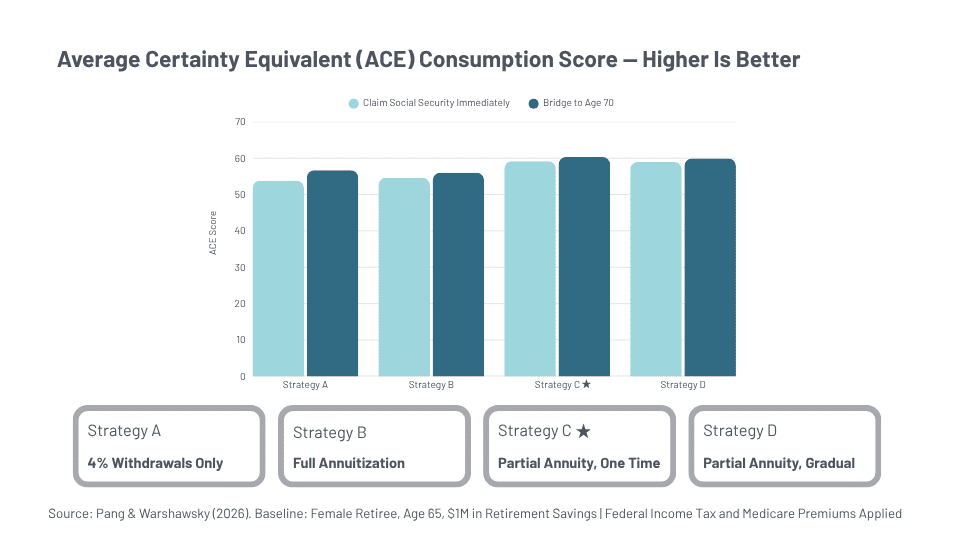
The study stress tests four strategies for drawing down retirement savings:
Across almost all cases tested, partial annuitization — either through a one-time or gradual annuity purchase — produced better outcomes.
Full annuitization maximizes income stability but eliminates liquidity and leaves nothing for heirs. Pure withdrawals preserve flexibility but expose retirees to significant longevity and sequence-of-returns risk. Splitting the difference captures the advantages of both.
This finding held across varying wealth levels, health statuses, risk preferences, and market conditions.
The study provides a clear view of how SECURE 2.0 is already providing a benefit to retirees.
Previously, the minimum distribution rules disadvantaged partial annuitization strategies because total distributions were taxed more heavily than straight withdrawal strategies. SECURE 2.0 removes that extra layer of taxation, saving money for retirees who choose lifetime income.
For most retirees, using savings as a “bridge” to delay Social Security claiming until age 70 improved lifetime financial outcomes across every income strategy tested. This provides a higher inflation-indexed income floor that reduces dependence on market performance and mitigates the risk of outliving assets.
For the millions of Americans navigating retirement without a pension, the combination of partial annuitization and strategic Social Security timing can help them create lifetime income that mimics a pension. The research underscores that optimal retirement income strategies vary meaningfully by wealth level, health, retirement age, and personal preferences. However, across the board, the bottom line: Americans need access to options that help them ensure they have savings to last.

Andrew Remo serves as Vice President, Retirement Security for the American Council of Life Insurers. In this capacity, he plays a leading role in advocating for policies that help people access the tools they need to save and ensure those savings last a lifetime. Previously, Andrew worked on these issues for the American Retirement Association and on Capitol Hill.